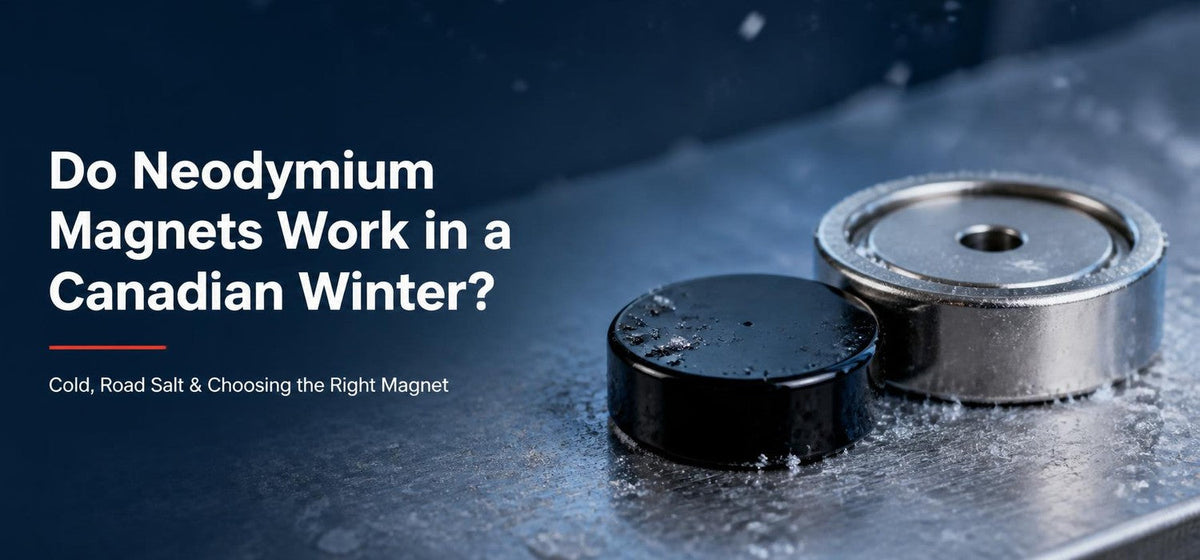
Do Neodymium Magnets Work in a Canadian Winter? Cold, Road Salt and Choosing the Right Magnet
Yes. Neodymium magnets get about 0.12% stronger for every degree Celsius they cool, so at −40°C a standard magnet is roughly 7% stronger than at room temperature. What fails in winter is the coating, mounting or handling, not the magnetism.
- Cold raises remanence (Br) by about 0.12% per °C below 20°C for standard N grades, and the change is fully reversible.
- Neodymium only loses strength from cold near −138°C, about 75°C colder than Canada's all-time record low.
- Heat is the real enemy: standard N35–N48 grades are rated to 80°C, and N50/N52 to just 60°C.
- Canada spreads about 5 million tonnes of road salt each year, which attacks nickel plating far faster than epoxy.
- For wet, salty or outdoor use, specify an epoxy or nylon coating, or a steel-cup (cap) magnet that shields the edges.
Every autumn we hear the same question from customers across Canada: will my magnets still hold when it hits −30°C? The worry makes sense, because so many materials behave badly in the cold. Rubber stiffens, batteries fade and plastics crack.
Neodymium magnets are different. The physics actually works in your favour in winter. The real risks come from the environment around the magnet, and those are easy to design for once you know them.
What Happens to a Neodymium Magnet in the Cold?
A neodymium magnet's flux density rises as it cools and falls as it warms. This follows its temperature coefficient of remanence (αBr), which is −0.12% per °C for standard N grades, per Magfine's neodymium property specifications. Within the normal operating range, the change reverses completely when the magnet returns to room temperature.
The table below applies that coefficient to typical Canadian conditions. Pull force scales roughly with the square of flux density at contact, so its change is about double the Br change.
| Temperature | Where you'd see it | Br vs 20°C | Approx. pull force |
|---|---|---|---|
| −40°C | Prairie cold snap, northern Ontario | +7.2% | about +15% |
| −20°C | Typical January night in Winnipeg or Regina | +4.8% | about +10% |
| 0°C | Unheated garage, Toronto winter day | +2.4% | about +5% |
| 20°C | Room temperature (rated values) | 0% | 0% |
| 60°C | Engine bay, sun-baked enclosure | −4.8% | about −9% |
| 80°C | Max rating for N35–N48 | −7.2% | about −14% |
Pull-force figures are Magfine estimates from αBr = −0.12%/°C. Real results also depend on shape, air gap and the steel you attach to. Check a specific size with the Magfine Magnet Calculator.
Can It Ever Get Too Cold for a Neodymium Magnet?
Only in a lab. Below about −138°C (135 K), the Nd₂Fe₁₄B crystal undergoes a spin reorientation: its preferred magnetization direction tilts away from the main axis, and the magnet's useful output drops. This transition is well documented in materials research, including work at the University of British Columbia. It only matters in cryogenic equipment, not in weather.
Yellowknife's record low is −51.2°C (Slice), and Canada's all-time record is −63°C at Snag, Yukon, in 1947. Both are far above the spin reorientation point. No weather in Canada can weaken a neodymium magnet through cold alone.
What Actually Goes Wrong with Magnets in Winter?
Winter failures are almost always corrosion or mechanical damage. Neodymium magnets are roughly two-thirds iron and corrode from the inside out once moisture reaches the core, as covered in our guide to neodymium corrosion and coatings.
1. Road Salt and Brine
About 5 million tonnes of road salt are spread on Canadian roads each year, according to Environment and Climate Change Canada. Salt spray and brine reach magnets on vehicles, trailers, loading docks and outdoor signage.
Standard nickel-copper-nickel plating can show rust within 24–48 hours of salt spray testing. Magfine's HDC epoxy showed under 1% mass loss after 408 hours of ISO 14993 salt spray testing.
2. Condensation
A magnet carried from −20°C outside into a warm, humid shop collects condensation within minutes. Repeated daily, that moisture finds any pinhole or chipped edge in the coating. Let parts warm up in a sealed bag, or use a pinhole-free coating.
3. Freeze–Thaw at Chipped Edges
Water that gets under a chipped coating can freeze, expand and lift more coating each cycle. Edges and corners fail first, which is why coating thickness at the edges matters as much as on flat faces.
4. Brittleness and Handling
Sintered neodymium is hard and brittle at any temperature. In winter, the usual causes of cracks are magnets snapping together while handled in thick gloves, impacts from ice or snow-clearing equipment, and thermal shock, such as placing a frozen magnet straight onto a hot surface.
5. Coating Temperature Limits
Coatings have cold limits too. Magfine's MF304 epoxy coating is specified for −30°C to 200°C. Nylon 11 coatings are noted for excellent low-temperature impact resistance and UV stability outdoors, which makes them a strong choice for exposed northern installations.
Don't Forget Heat: The Bigger Risk, Even in Winter
Heat, not cold, causes permanent magnet loss. Winter brings its own heat sources: engine bays, block heaters, heated floors, furnace ducts and space heaters. If a magnet runs above its rated temperature, part of its strength does not come back.
The letter after the grade number tells you the heat rating. Values below are from Magfine's property specifications, measured at a height-to-diameter ratio of 0.7. Thin magnets tolerate less.
| Grade suffix | Example grades | Max working temperature |
|---|---|---|
| None (highest energy) | N50, N52 | 60°C |
| None (standard) | N35–N48 | 80°C |
| M | 35M–50M | 100°C |
| H | 33H–48H | 120°C |
| SH | 30SH–45SH | 150°C |
| UH | 28UH–40UH | 180°C |
| EH | 28EH–38EH | 200°C |
| AH | 28AH–33AH | 230°C |
Source: Magfine Neodymium Magnet Property Specifications.
The strongest grade is not always the right one. An N52 magnet near an engine block can lose more strength than an N42SH of the same size. See our guide to choosing a magnet grade for the trade-offs.
How to Choose a Magnet for Outdoor or Winter Use in Canada
Match the coating and housing to the exposure first, then pick the grade for the hottest temperature the part will see.
- Define the exposure. Indoor and dry, outdoor but sheltered, or direct contact with salt, slush or wash-down water.
- Pick the coating. Nickel plating suits dry, sealed indoor use. For outdoor, salty or wet conditions, choose epoxy resin coated magnets. For exposed sites colder than −30°C, or where impacts are likely, ask about nylon coating.
- Protect the edges. A cap neodymium magnet sits in a steel cup that shields the brittle edges and concentrates holding force on one face. Countersunk and threaded versions mount with standard hardware.
- Check the hottest point, not the coldest. Use the grade table above. Near engines or heaters, step up to an M, H or SH grade.
- Size for the real gap. Ice, paint, a plastic housing or a winter-glove layer all add air gap and cut pull force sharply. Read why in Why Neodymium Magnet Pull Force Is Lower in Real-World Applications.
- Handle carefully in the cold. Keep magnets in their packaging or with spacers, slide them apart rather than prying, and let cold parts warm up before installing them on heated equipment.
Frequently Asked Questions
Do magnets get weaker in the cold?
No. Neodymium magnets get slightly stronger as they cool, about 0.12% more flux density per °C for standard grades. They only weaken from cold below about −138°C.
Do magnets work at −40°C?
Yes. At −40°C a standard neodymium magnet is roughly 7% stronger in flux density than at 20°C, and the change reverses when it warms up.
Will a neodymium magnet rust outside in winter?
A nickel-plated magnet exposed to road salt or slush will usually rust, often starting at the edges. Epoxy- or nylon-coated magnets, or magnets in a sealed steel cup, last far longer outdoors.
Does cold make neodymium magnets brittle?
Neodymium is brittle at any temperature. Most winter breakage comes from magnets snapping together during gloved handling, impacts from ice or equipment, and thermal shock.
Can I leave a magnetic sign on my car all winter?
Remove and clean flexible magnetic signs regularly in winter. Salt, grit and moisture trapped underneath can mark the paint and weaken the hold.
What is the best magnet grade for outdoor use in Canada?
For most outdoor uses, a standard N35–N48 grade is fine, because winter cold is not a limit. Choose the coating for the exposure, and step up to an M, H or SH grade only if the magnet sits near a heat source.
Sources
- Magfine – Neodymium Magnet Property Specifications
- Magfine – High-density Coating (MF304, MF305, Nylon)
- Magfine – Corrosion in Neodymium Magnets
- University of British Columbia – Magnetic features of Nd₂Fe₁₄B through the spin reorientation transition
- Environment and Climate Change Canada – Road Salts FAQ
- Slice – Canada's Coldest Cities