Pull Force vs. Gauss: Which One Actually Matters When Choosing a Magnet?
- Gauss is a measure of field intensity. Pull force is a measure of mechanical holding force. Different units, different purposes.
- A higher Gauss rating doesn't automatically mean a higher pull force. Size and contact area usually matter more.
- Sensors, switches, and encoders care about Gauss. Latches, fixtures, and holding applications care about pull force.
- What the magnet is holding onto (steel grade, thickness, coatings) affects pull force about as much as the magnet does.
- Air gap, load direction (straight pull vs. shear), heat, and time all move the real number away from the datasheet rating.
- Magfine's calculator gets you a good starting estimate. Testing the actual assembly is still the last step.
A few months back, a customer called in asking for "the highest Gauss magnet we had." He was working on a removable access panel and figured the magnet with the biggest Gauss number would also hold the most weight.
Once we got into the details of what he was building, it turned out Gauss wasn't really the spec he needed. What he needed was pull force: how much force it would take to yank the panel off the enclosure.
We have some version of this conversation more than you'd think. Gauss and pull force get lumped together constantly, partly because they're both on the datasheet and partly because both numbers go up when you switch to a bigger, more powerful magnet. It doesn't help that a lot of magnet marketing pages use "Gauss" and "strength" as if they were interchangeable, which reinforces the exact assumption that trips people up. But they're not measuring the same thing at all, and once you see the difference, it's hard to unsee.
What Each Number Is Actually Telling You
Gauss is field intensity: how concentrated the magnetic field is at a given point, usually measured right at the magnet's surface. It tells you something about the field itself, nothing about what the magnet is attached to.
Pull force is the mechanical force needed to physically separate a magnet from a piece of steel, usually given in pounds or kilograms. Unlike Gauss, it's not really a property of the magnet on its own. It depends on the steel it's stuck to, the distance between them, and the direction you're pulling.
A small, ultra-bright LED can throw an intensely concentrated beam and still do a poor job lighting up a room. A bigger, dimmer floodlight often wins that fight even though its peak brightness is lower. Magnets aren't so different.
How Gauss Numbers Actually Get Measured
One thing that trips people up when they're comparing datasheets: the Gauss number listed isn't measured the same way by every supplier. Most report what's called surface Gauss, meaning a Hall-effect probe was held directly against the center of the magnet's face. Move that same probe off-center by even half a centimeter and the reading can drop noticeably, because the field isn't uniform across the face of a magnet. It's strongest at the center and tapers off toward the edges.
That's part of why comparing two magnets by Gauss alone can be misleading before geometry ever enters the picture. A supplier measuring dead-center will report a higher number than one measuring slightly off-axis, even on otherwise identical magnets. Nobody's being dishonest here, it's just a different measurement point. If a quoted Gauss figure is doing a lot of work in your decision, it's worth asking where on the magnet that number was actually taken.
Where Gauss Is the Number You Actually Want
We'd push back on the idea that Gauss is some outdated or secondary spec. It's the number that matters most whenever the application cares about the field itself, not how much force the magnet can physically exert. Hall effect sensors, reed switches, magnetic encoders, position detection, medical equipment, inspection gear, separation systems. All of it comes down to field strength at a given distance.
A Hall effect sensor sitting a few millimeters from a magnet doesn't care how many pounds of pull force that magnet could theoretically generate against a steel plate. It's reading field intensity at that gap, and that's what trips the switch or encodes the position. In a rotary encoder, for instance, a small magnet spins past a sensor dozens or hundreds of times a second, and the sensor is reading how the field direction and intensity change through that rotation. Pull force never enters the calculation.
Where Pull Force Is the Number You Actually Want
Flip over to door latches, fixtures, automation, magnetic bases, tool holders, retail displays, robotic grippers. Nobody's asking about Gauss anymore. The question is simpler: will it hold the part?
A magnetic latch has one job: keep a panel shut until someone deliberately pulls it open. Field intensity at the surface doesn't tell you whether it'll survive that pull. Pull force does.
Why a Tiny High-Gauss Magnet Can Lose to a Big One
Here's the part that catches even people who already know the two specs are different. Take a 3 mm N52 disc, with surface Gauss through the roof, and put it next to a 50 mm N42 block, whose surface Gauss is noticeably lower.
Go by Gauss alone and you'd bet on the disc. In an actual pull test, the block wins by a wide margin. The reason comes down to total flux rather than peak intensity. There's simply more magnetic material generating the field, a larger area actually touching the steel, a bigger and more efficient magnetic circuit for the flux to travel through, and less of that flux leaking off uselessly into the surrounding air.
A tiny high-Gauss magnet crams a strong field into a small footprint, which is exactly what a sensor a few millimeters away needs. For holding, though, that same field is mostly wasted, because a small piece of steel can't absorb all of it.
Grade Numbers Add a Third Variable
Magnet grade complicates the picture in a similar way. Neodymium magnets are graded N35 through N52, and higher-performance specialty alloys go further still. The number refers to maximum energy product, a lab measurement of how much magnetic energy the material can store per unit volume. Higher grade generally means a stronger magnet for a given size, but the effect is smaller than most people expect.
Take an identical disc and bump it from N42 to N52, and pull force typically climbs somewhere around 10 to 15 percent, not double, even though N52 sounds dramatically stronger on paper. Geometry still does most of the heavy lifting. We've had customers assume that jumping a grade would fix a holding problem, when going up one size in diameter, which is often cheaper, solved it more effectively than the grade change would have.
Pot Magnets Take the Geometry Argument Further
There's a category of magnet that makes the geometry point almost impossible to ignore: pot magnets, sometimes called cup magnets. Instead of a bare disc or block sitting out in the open, the magnet is housed inside a steel cup that wraps around its back and sides, leaving only the working face exposed.
That steel housing does something clever. It channels flux that would otherwise leak out the sides and back of a bare magnet and redirects it out through the working face instead. The result is a pull force rating that can run two to three times higher than a bare magnet of the same grade and diameter, even though the surface Gauss reading on the exposed face barely changes.
We bring this up because it might be the clearest illustration of the whole article. A pot magnet doesn't have a dramatically higher Gauss rating than the bare magnet sitting inside it. What's different is the magnetic circuit built around it. Engineers designing holding fixtures, tool mounts, or industrial hangers often reach for pot magnets specifically because pull force per dollar, and pull force per unit of installed space, tends to beat a bare magnet of similar size by a wide margin. The tradeoff is cost, since a pot magnet involves an extra machined or stamped steel housing, and they generally only work where field exposed from a single face is enough.
Distance Is the Silent Killer
If there's one variable that catches people off guard more than any other, it's air gap: any distance between the magnet and the steel, whatever the cause.
Magnetic field strength doesn't fall off gradually with distance. It drops fast, closer to a cube-law relationship than a straight line, depending on the geometry involved. A magnet rated at 20 lbs of pull force in direct contact might only manage 5 or 6 lbs with a 1 mm gap between it and the steel. Push that gap out to 3 mm and the number falls further still, sometimes down to a small fraction of the direct-contact rating.
This is why published pull force numbers always assume zero gap, and it's also why a magnet that performs beautifully on the bench can disappoint once it's mounted behind an enclosure wall, a layer of foam, or a coat of paint. None of those layers need to be thick to matter. A gap you can barely measure with calipers can still cut holding force in half.
Straight Pull vs. Sideways Load
Published pull force numbers describe one specific kind of load: a straight pull, directly away from the steel surface. Plenty of real applications don't load a magnet that way at all.
Think about a sliding cabinet catch, a magnetic drawer stop, or a sign panel that slides into a channel and gets held there magnetically. In each case, the load is mostly sideways, or shear, rather than a straight pull-off. Shear strength is a different number entirely, and it depends heavily on friction between the two surfaces, not just the magnetic circuit alone. A polished, low-friction surface can let go under a shear load that a rougher surface would happily resist.
If a design loads the magnet mostly in shear, the pull force rating on the datasheet won't tell you much on its own. It's worth testing that specific load direction directly rather than assuming the published number carries over.
The Steel Side of the Equation Gets Ignored
Customers usually find this out the hard way, during testing, because it's not something manufacturers put much emphasis on: pull force depends as much on what the magnet is attracting as it does on the magnet itself.
Every published rating assumes a reference condition: a thick plate of mild steel, clean and flat, in direct contact. Change any of that and the real number moves, even though nothing about the magnet changed. A stainless steel that looks identical to mild steel can be far less magnetically responsive. Steel that's too thin can't carry the full magnetic circuit, so pull force drops regardless of how strong the magnet is. A layer of paint, plating, or even light rust adds exactly the kind of gap described above, and it's often enough to matter. Warped or textured steel reduces the actual contact area too, which quietly eats into the number.
More than once we've had a customer convinced the magnet was underperforming, only to trace it back to a thin sheet of mild steel that couldn't carry the flux the magnet was capable of producing. The magnet was doing its job. The steel just wasn't giving it enough to work with.
Heat and Time Change the Numbers Too
Pull force isn't fixed for the life of the magnet, either. Neodymium magnets lose some strength as they heat up, and how much depends on grade. Standard N42, for example, is typically rated to around 80°C before it starts losing performance in a way that doesn't fully come back once it cools. Specialty grades with suffixes like SH, UH, or EH are formulated to hold up at higher temperatures, usually at the cost of a slightly lower Gauss and pull force rating at room temperature.
For anything mounted near a motor, inside an engine bay, or sitting in direct sun in a hot climate, that temperature rating matters about as much as the pull force number on the box. A magnet that permanently loses 10 or 15 percent of its strength at operating temperature can turn a comfortable safety margin into a tight one.
Corrosion plays a similar long game. Neodymium corrodes quickly on its own, which is why nearly every commercial magnet comes with a nickel, zinc, or epoxy coating. If that coating gets scratched or worn through over years of use, the exposed material starts to degrade, and performance drifts downward slowly enough that nobody notices until it's already a problem.
Getting a Number Before You Build Anything
When someone's trying to estimate holding force before committing to a design, we point them to Magfine's Pull Force Calculator. It's a fast way to compare magnet sizes and shapes theoretically, before spending money on prototypes.
The calculator assumes ideal conditions: thick mild steel, flat contact, no coatings, no gaps. Real assemblies rarely match that exactly, so treat the result as a starting point, not a final answer.
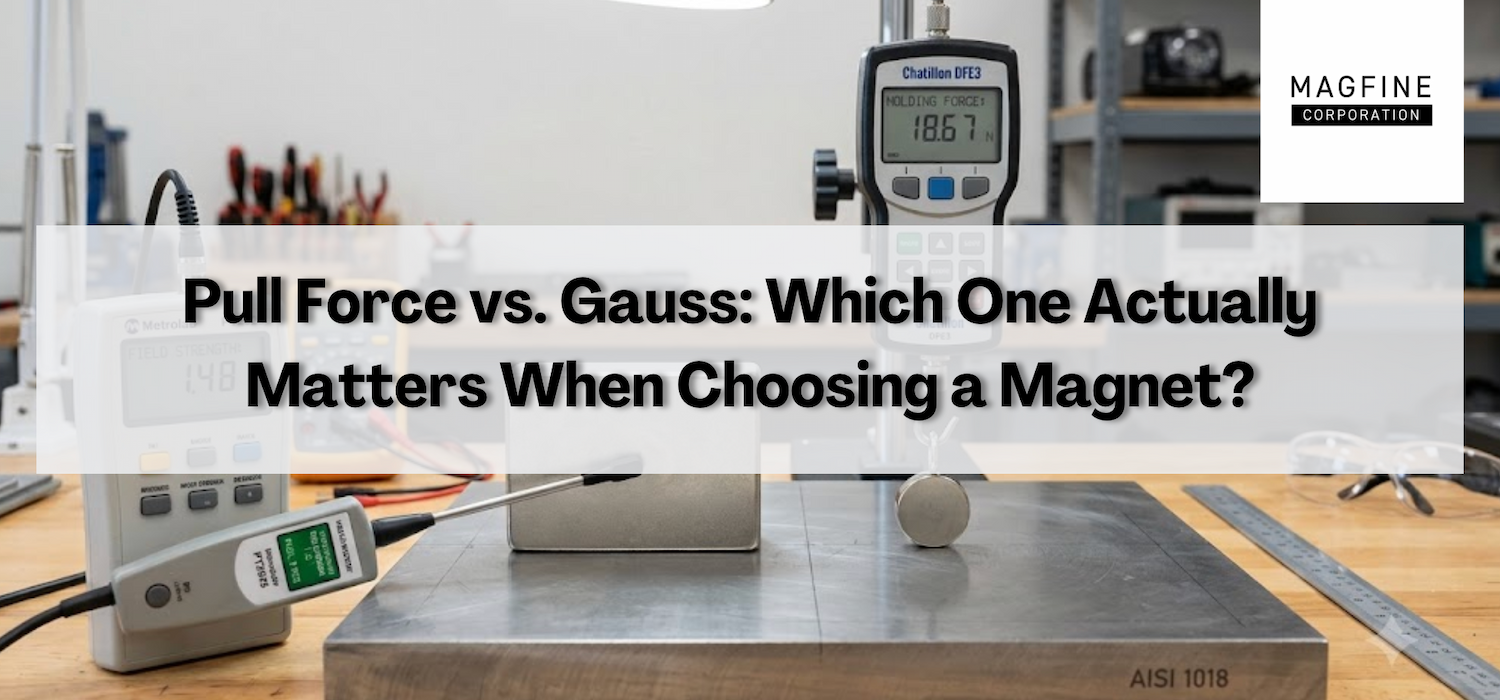
Once you've got a shortlist from the calculator, the next step is putting an actual sample against the actual material your product will use, in the actual orientation it'll be loaded, and pulling it apart with a force gauge. It doesn't need to be complicated. A basic digital force gauge and a handful of sample magnets will tell you more in an afternoon than another hour of spec-sheet comparison ever will.
Build in a safety margin while you're at it. If a design genuinely needs to hold 10 lbs, most engineers won't spec a magnet rated for exactly 10 lbs. Vibration, repeated cycling, minor misalignment, and the wear that shows up after a few thousand open-and-close cycles all chip away at that number over time. A target of two to three times the actual load is a common starting point, though the right margin depends on how forgiving the application is if the magnet underperforms.
Magnetic Pull Force Calculator
Narrow down magnet size and shape early, then confirm with a prototype once the design settles.
Use the CalculatorA Few Questions We Get Asked Often
Does a higher Gauss rating mean a stronger magnet?
Not necessarily. It means a more concentrated field at the point where it was measured. Whether that translates into more holding force depends on the magnet's size, shape, and how much of it actually contacts the steel. Two magnets with very different Gauss ratings can end up with nearly identical pull force, or wildly different pull force, depending on geometry.
Can I convert a Gauss rating into a pull force number with a formula?
Not reliably. Pull force depends on too many variables outside the field itself, including steel grade, thickness, surface condition, and air gap. A calculator like Magfine's gives a theoretical estimate based on standard assumptions, but there's no simple universal formula that converts one number into the other for a specific real-world setup.
What's a reasonable safety margin for a holding application?
Most engineers target two to three times the actual load the magnet needs to hold, and more than that if the application involves vibration, repeated cycling, or temperature swings. The right number depends on how forgiving the design is if the magnet underperforms even slightly.
Is a bigger magnet always a better choice than a higher grade?
For pull force, size usually wins over grade. Going up in diameter or thickness tends to add more holding force than jumping a grade or two on an identically sized magnet. Grade matters more in space-constrained designs where increasing size simply isn't an option.
Why does a magnet that feels strong on my fridge barely hold anything in my project?
Usually one of two things: an air gap you're not accounting for, like a plastic housing wall or a coat of paint, or a steel surface that isn't giving the magnet enough material to complete the magnetic circuit. Fridges are typically decent-thickness mild steel with direct contact, which is close to the ideal conditions the datasheet assumes. Most real products aren't.
Both Numbers Matter, Just Not for the Same Reasons
When someone asks whether to pay attention to Gauss or pull force, our answer is usually both, depending on what they're building.
For a latch, a fixture, or anything that needs to physically hold on to a part, pull force is the number that predicts whether it'll actually work. For sensors and switches, Gauss is the one that matters, because the field itself is the whole point.
Once you know which category your project falls into, the rest of the decision gets a lot simpler. Holding applications shift the conversation toward size, contact area, and steel condition rather than chasing the highest grade on the shelf. Sensing applications shift it toward field strength at a known distance, which is a different design problem with a different set of tradeoffs entirely.
Picking the right spec for the job is usually what separates a project that goes smoothly from one that gets redesigned three weeks in.